



Critical thinking is a vital skill that helps individuals analyze information, solve problems effectively, and make decisions based on logic and reasoning. It is not just an academic skill but one that is useful in everyday life, whether in the workplace, personal relationships, or while facing complex challenges.
By developing your critical thinking abilities, you can approach problems more systematically and objectively, making better decisions and improving problem-solving skills. In this article, we will explore key critical thinking exercises and their importance.
Importance of Critical Thinking
Critical thinking goes beyond just thinking about what you know—it involves actively engaging with information, questioning assumptions, and analyzing the validity of arguments. It helps individuals make decisions that are based on facts and reasoning rather than emotions or biases. The importance of critical thinking can be seen in its numerous benefits:
- Improved Decision-Making: Critical thinking allows you to consider all factors before making decisions, leading to more informed and thoughtful choices.
- Better Problem-Solving: Critical thinkers approach problems methodically, breaking them down into manageable parts and identifying the best solutions.
- Enhanced Creativity: Critical thinking fosters creativity by encouraging individuals to think outside the box and challenge traditional methods.
- Stronger Communication Skills: Being able to reason clearly helps in articulating thoughts effectively and persuading others based on evidence.
How Critical Thinking Improves Problem-Solving Skills
Problem-solving is at the heart of critical thinking. When faced with a problem, critical thinking helps individuals identify the issue, gather information, analyze possible solutions, and choose the best course of action. Critical thinking enhances problem-solving in the following ways:
- Breaking Down Complex Issues: Critical thinking helps simplify complex problems by breaking them down into smaller, more manageable tasks.
- Evaluating Alternatives: It encourages the exploration of different perspectives and solutions, considering both advantages and risks.
- Assessing Evidence: Critical thinking emphasizes evaluating evidence to support decisions, ensuring they are based on facts, not assumptions.
Essential Critical Thinking Exercises
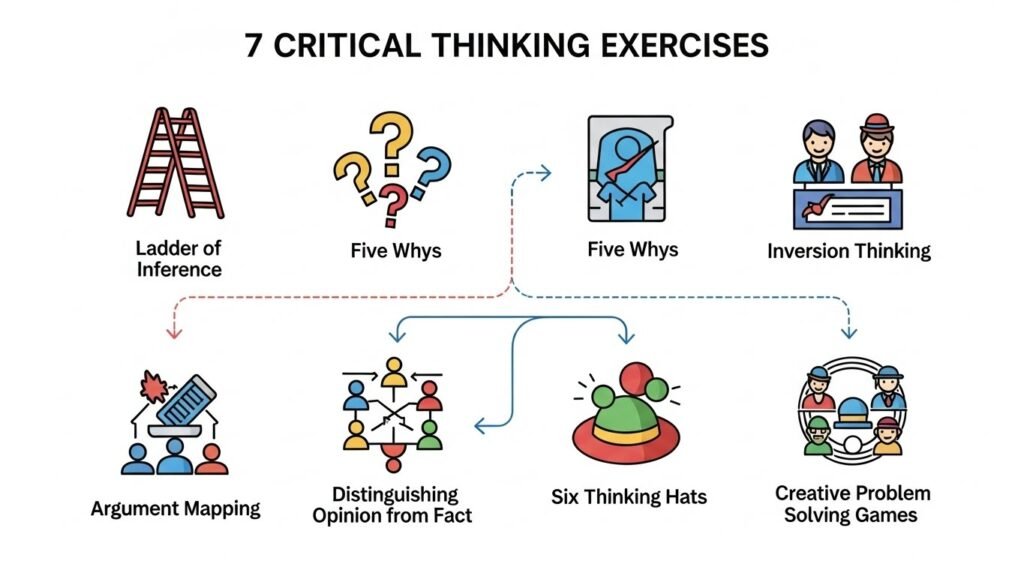
Now that we understand the importance of critical thinking, let’s explore some exercises that can help improve these skills. These exercises are practical and can be used both in personal and professional settings to build stronger critical thinking abilities.
The Ladder of Inference
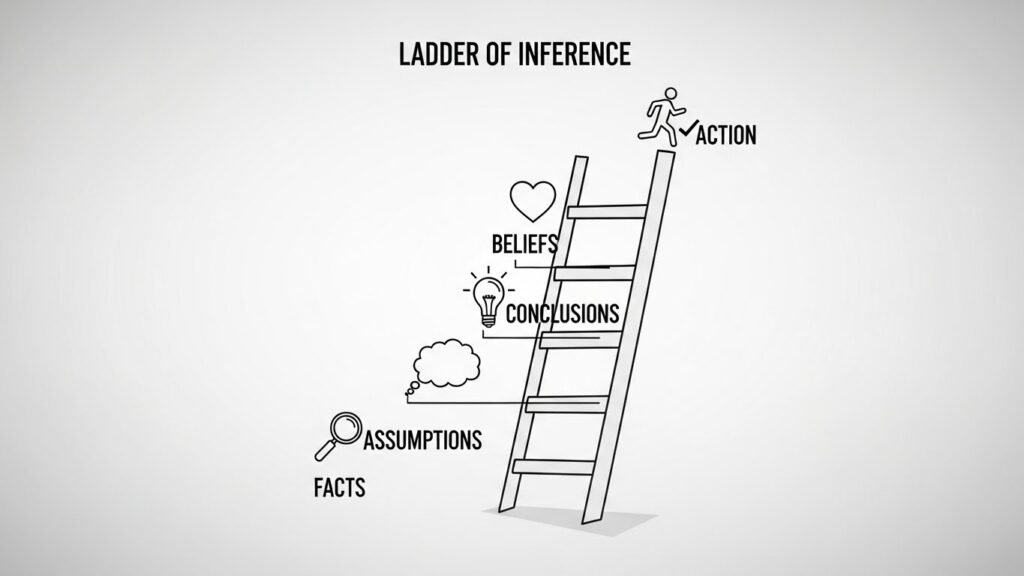
The Ladder of Inference, developed by Chris Argyris, is a tool that helps individuals understand how they arrive at conclusions. This exercise encourages you to reflect on the steps you take—from observing facts to making assumptions—so you can evaluate whether your reasoning is sound.
Exercise Steps:
- Step 1: Identify the facts you observed.
- Step 2: Recognize the assumptions you made based on those facts.
- Step 3: Analyze how those assumptions influenced your conclusions.
- Step 4: Question whether your conclusions are valid or if they were shaped by biases.
This exercise is helpful in understanding the mental process behind decisions and ensuring that they are based on accurate information rather than assumptions.
The Five Whys Technique
The Five Whys technique is a simple yet effective method used to identify the root cause of a problem. It involves asking “Why?” five times to dig deeper into the issue at hand.
How to Use the Five Whys:
- Identify the Problem: What is the issue you are facing?
- Ask Why: Why did this happen?
- Ask Why Again: Keep asking “Why?” for each answer to get closer to the root cause.
- Continue Asking: Repeat the process until you identify the underlying cause.
This exercise helps uncover deeper insights and allows you to focus on solving the root cause rather than just addressing surface-level symptoms.
Inversion Thinking
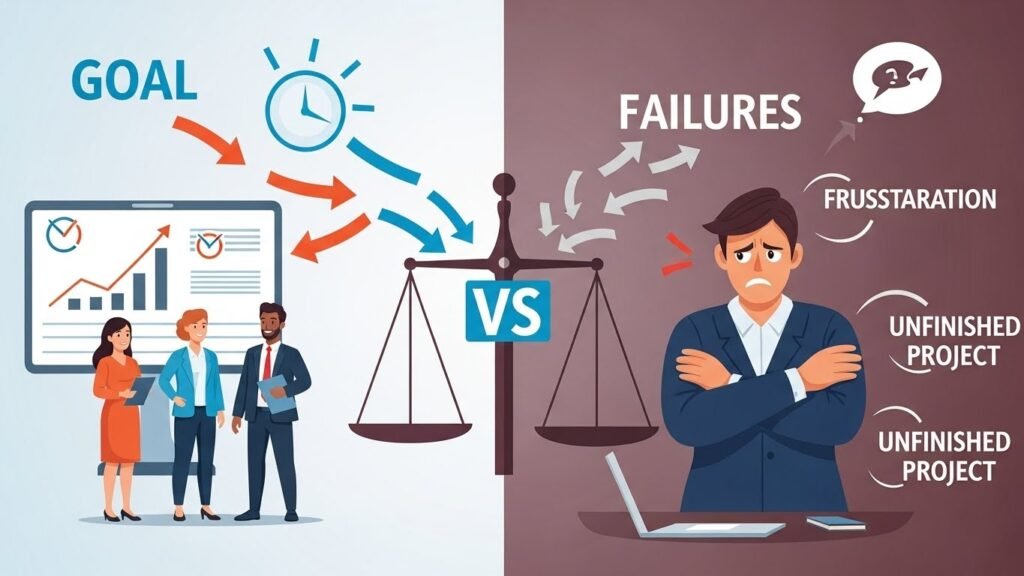
Inversion thinking helps you approach problems from the opposite perspective. Rather than thinking about how to achieve a goal, consider what you could do to prevent success. This exercise helps identify potential obstacles that may not be immediately apparent.
Exercise Steps:
- Define Your Goal: What is it you want to achieve?
- Think About Failure: What actions or behaviors would lead to failure in achieving this goal?
- Identify Obstacles: Consider the challenges or pitfalls that could hinder success.
- Avoid the Failures: Once you recognize the potential obstacles, plan your actions to avoid them.
Inversion thinking encourages you to think proactively about what could go wrong, allowing you to better prepare for success.
Argument Mapping

Argument mapping is a visual tool that helps break down complex arguments into logical components. By mapping an argument, you can clearly identify the premises, evidence, and conclusions, which allows for a better understanding of the reasoning behind a claim.
How to Create an Argument Map:
- Identify the Main Claim: Start by writing down the central argument or claim being made.
- List the Premises: Identify the supporting reasons or evidence that back up the main argument.
- Analyze the Structure: Assess how each premise leads to the conclusion. Are the premises logically connected? Are there gaps in reasoning?
- Consider Counterarguments: Look for opposing views or weaknesses in the argument. This helps strengthen your ability to evaluate different perspectives.
Argument mapping is a powerful tool for assessing the validity of an argument and making sure you’re not overlooking critical details.
Distinguishing Opinion from Fact

In any situation, it’s crucial to separate facts from opinions. A fact is an objective statement that can be verified, while an opinion is subjective and reflects a personal belief or perspective. This exercise sharpens your ability to critically evaluate the information presented to you.
How to Distinguish Opinion from Fact:
- Examine the Statement: Does the statement provide verifiable information or is it based on personal feelings, beliefs, or preferences?
- Check for Evidence: Can the statement be backed up with data, studies, or observable facts, or is it solely an individual’s viewpoint?
- Identify Biases: Is the statement influenced by any biases or assumptions? Opinions often reflect personal biases, while facts are neutral and supported by objective evidence.
By practicing this exercise, you can develop the habit of questioning information, leading to more rational decision-making based on facts rather than opinions.
Six Thinking Hats

The Six Thinking Hats technique, developed by Edward de Bono, encourages individuals to approach problems from different perspectives. This technique helps generate well-rounded solutions by considering all angles, including emotions, logic, creativity, and potential risks.
How to Use the Six Thinking Hats:
- White Hat: Focus on facts and information. What do you know? What are the relevant data points?
- Red Hat: Consider emotions and feelings. How do you feel about this issue? What emotional responses are influencing your perspective?
- Black Hat: Think critically about potential downsides. What are the risks or problems with this idea?
- Yellow Hat: Focus on the positives. What are the benefits or opportunities of this solution?
- Green Hat: Encourage creative thinking. What unconventional or innovative ideas can solve this problem?
- Blue Hat: Take a step back and manage the thinking process. What steps should be taken next?
This exercise helps you consider multiple aspects of a problem, ensuring that decisions are well-rounded and thoroughly evaluated.
Fun and Practical Critical Thinking Games

Critical thinking exercises don’t always have to be formal or structured; they can also be fun and engaging activities that enhance problem-solving skills while promoting teamwork and creativity. Below are some enjoyable games that can be used to develop critical thinking.
Egg Drop Challenge
The Egg Drop Challenge is a creative problem-solving game that requires participants to design a structure that will protect an egg from breaking when dropped from a height. It encourages teamwork, creativity, and practical application of critical thinking.
How to Play:
- Split participants into teams and provide materials like straws, rubber bands, and tape.
- Each team must design a structure to protect an egg from being dropped from a height.
- After building the structures, drop the eggs from a designated height and see if they survive the fall.
This activity fosters teamwork and creative thinking, as participants must evaluate their designs critically and adjust their strategies based on the results.
Improv Games
Improv games require participants to think quickly, adapt to changing situations, and use their creativity to solve problems on the spot. These exercises are excellent for developing flexibility and improving communication skills.
How to Play:
- Organize a series of improv exercises where participants have to act out scenarios with minimal preparation.
- The scenarios can range from business situations to fun, unexpected prompts that challenge participants to think creatively and react in real-time.
Improv games are great for improving quick thinking and helping participants step outside their comfort zones.
Escape Room Challenge
Escape rooms are interactive games that require participants to solve puzzles, decipher clues, and work together to “escape” a locked room within a set time. These challenges require team collaboration, critical thinking, and problem-solving under pressure.
How to Play:
- Divide participants into teams and assign each team to an escape room challenge.
- Teams must solve puzzles, decode clues, and collaborate effectively to escape the room before the time runs out.
Escape rooms encourage critical thinking in a fast-paced, time-sensitive environment, making them an excellent choice for team-building and problem-solving.
Murder Mystery Activity
Murder mystery games are engaging exercises that require participants to use logic, deduction, and teamwork to solve a fictional crime. These games are fun yet mentally challenging, making them perfect for enhancing reasoning and evaluation skills.
How to Play:
- Assign roles to participants (detective, suspect, witness, etc.) and give them a scenario to solve.
- Participants must analyze clues, evaluate testimonies, and use their critical thinking skills to identify the murderer.
Murder mystery activities encourage participants to think critically, assess evidence, and collaborate with others to solve a problem.
Puzzle-Solving Relay
In this team-based challenge, participants work together to solve a series of puzzles within a limited time. The goal is to test both problem-solving skills and teamwork, making it a great way to build critical thinking in a group setting.
How to Play:
- Divide participants into teams and give each team a set of puzzles to solve.
- The team that completes all the puzzles first wins.
This exercise promotes collaboration and encourages participants to think quickly and logically under pressure.
Role-Playing Activities
Role-playing allows participants to act out different scenarios, helping them build empathy, practice problem-solving, and evaluate different perspectives. It also encourages participants to consider multiple viewpoints when making decisions.
How to Play:
- Present a scenario and assign roles to each participant.
- Participants must act out their roles and navigate the situation, considering the motivations and perspectives of the characters they are portraying.
Role-playing exercises are a fun and effective way to develop critical thinking while encouraging participants to approach problems creatively and from different perspectives.
Applying Critical Thinking in Real-World Situations

Building Critical Thinking into Everyday Decisions
Critical thinking is not confined to specific exercises or formal environments. It can be applied to everyday situations, making it a valuable skill in both personal and professional life. By regularly using critical thinking techniques in daily decision-making, you can approach life’s challenges with more clarity and confidence.
How to Apply Critical Thinking in Everyday Decisions:
- Question Assumptions: In any situation, ask yourself what assumptions you might be making. Are there any biases or preconceived notions influencing your thinking? By questioning assumptions, you can open yourself up to new possibilities and more accurate conclusions.
- Analyze Outcomes: Consider the potential outcomes of your decisions before acting. Think through the various options, weighing the potential pros and cons of each.
- Evaluate the Information: In the age of information overload, not everything you read, hear, or see is accurate or helpful. Critical thinking involves evaluating the credibility of the sources of information and assessing how reliable it is before using it to make decisions.
Applying critical thinking to everyday situations improves decision-making by ensuring that choices are based on logic, evidence, and careful evaluation, not just on instinct or hearsay.
Critical Thinking for Personal Development
Personal development is about improving yourself to achieve your goals and become a better version of yourself. Critical thinking plays a major role in this process, as it enables you to assess your actions, beliefs, and thought patterns, helping you grow and evolve over time.
Ways Critical Thinking Supports Personal Development:
- Self-Awareness: Critical thinking encourages self-reflection, which helps you become more aware of your strengths, weaknesses, and personal biases. This self-awareness is key to improving how you respond to challenges and make decisions.
- Goal Setting: When setting personal goals, critical thinking allows you to analyze your current situation, identify areas for improvement, and create realistic action plans.
- Mindset Shift: By consistently applying critical thinking, you can shift from a fixed mindset (where you believe abilities are static) to a growth mindset (where you believe that skills can be developed). This shift is crucial for overcoming obstacles and adapting to new challenges.
Through regular practice, critical thinking not only enhances decision-making but also helps foster a mindset of continuous learning and improvement, essential for personal development.
Improving Emotional Intelligence with Critical Thinking
Emotional intelligence (EQ) is the ability to recognize and manage your own emotions, as well as the emotions of others. Critical thinking enhances emotional intelligence by encouraging self-reflection and improving emotional regulation. This allows for better communication, stronger relationships, and more effective conflict resolution.
How Critical Thinking Improves Emotional Intelligence:
- Self-Regulation: Critical thinking helps you pause and reflect before reacting emotionally. Instead of making impulsive decisions driven by strong feelings, critical thinkers are able to consider the situation logically and choose an appropriate response.
- Empathy: Being able to understand others’ emotions is an important aspect of EQ. Critical thinking encourages you to see things from other people’s perspectives, fostering empathy and better interpersonal connections.
- Effective Communication: Critical thinking improves communication by helping you express your thoughts clearly, ask insightful questions, and listen actively. By engaging with others thoughtfully, you can strengthen relationships and resolve conflicts more easily.
By using critical thinking to enhance emotional intelligence, you can better manage your emotions and interact more positively with others.
Applying Critical Thinking in Career Growth
In the professional world, critical thinking can set you apart from others and contribute to career advancement. Employers highly value employees who can think analytically, solve problems effectively, and make well-reasoned decisions.
How Critical Thinking Contributes to Career Growth:
- Decision-Making in Leadership: Strong critical thinking helps leaders make decisions that are both logical and strategically sound. It allows them to weigh different perspectives, identify risks, and lead teams to successful outcomes.
- Problem-Solving Skills: In the workplace, problems are inevitable. Critical thinking helps employees and leaders approach challenges systematically, finding creative solutions and preventing issues from escalating.
- Continuous Improvement: By practicing critical thinking, you can identify areas for improvement in your work processes, whether it’s streamlining a workflow, enhancing productivity, or improving team dynamics. This commitment to continuous improvement helps you stay ahead in your career.
By applying critical thinking in your career, you not only improve your individual performance but also contribute to the success and growth of the organization.
Conclusion
Critical thinking is an invaluable skill that enhances every aspect of life, from decision-making and problem-solving to emotional intelligence and career advancement. By regularly practicing exercises like the Ladder of Inference, the Five Whys, and Inversion Thinking, you can strengthen your ability to think critically, make better decisions, and solve problems more effectively.
Additionally, incorporating critical thinking into personal development, emotional intelligence, and career growth allows you to navigate life’s challenges with confidence and clarity. Whether you are making everyday decisions, leading a team, or fostering stronger relationships, critical thinking helps you approach each situation with logic, creativity, and insight.
By making critical thinking a part of your daily routine, you will develop the skills necessary to face complex problems head-on and achieve greater success in both your personal and professional life.
Frequently Asked Questions (FAQs)
1. What is critical thinking, and why is it important?
Critical thinking is the ability to analyze information, question assumptions, and make decisions based on logic. It’s important because it helps you solve problems, make better decisions, and avoid biases.
2. How can I improve my critical thinking skills?
You can improve critical thinking by practicing exercises like the Ladder of Inference and the Five Whys, reading, solving puzzles, and reflecting on your decisions. Challenging your assumptions and seeking feedback also helps.
3. What is the Ladder of Inference, and how does it help in critical thinking?
The Ladder of Inference is a model that shows how we move from facts to conclusions. It helps you spot any assumptions you might be making, so you can make decisions based on facts rather than biases.
4. How does critical thinking impact decision-making in the workplace?
Critical thinking helps you assess all options, consider risks, and make informed decisions. It leads to better problem-solving, clearer communication, and more effective decision-making in the workplace.
5. Can critical thinking improve emotional intelligence?
Yes, critical thinking helps you manage emotions and understand others better. It improves self-regulation, empathy, and communication—key aspects of emotional intelligence.

1 Comment
Pingback: How Can BI Exercises Improve Data-Driven Decision Making?